HARARE's urban capacity has long outstripped its original colonial design. Gridlocked roads, chronic office shortages and ageing infrastructure define daily life in the capital. Twenty kilometres west, at Mount Hampden, a blueprint for a new administrative smart city rises alongside nationwide airport expansions and transnational tourism highways—all sustained by Chinese financing, engineering expertise and technical training under the Forum on China-Africa Cooperation framework.
Beneath this sweeping construction drive lie tangible structural frictions: stalled land compensation disbursements, looming long-term fiscal liabilities, and unproven capacity to convert hard infrastructure into lasting economic gains. Written from an indigenous African analytical lens, this commentary dissects the development logic behind Zimbabwe’s infrastructure overhaul, weighs the tangible benefits of cross-border partnerships against deep-seated domestic bottlenecks, and soberly assesses the viability of its integrated urban, aviation and tourism growth strategy.
Rationale for Mount Hampden’s smart city vision
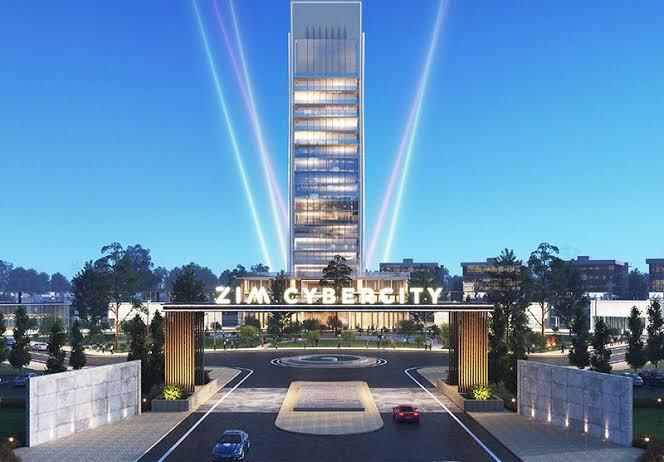
For decades, Harare has absorbed far more government ministries, foreign embassies and residents than its colonial-era layout was ever engineered to support. Decaying legacy infrastructure, perpetual traffic congestion and a permanent scarcity of commercial and administrative workspace have pushed municipal management costs steadily higher. Decentralising state administrative functions via a purpose-built satellite capital emerged as an inevitable policy response, giving birth to the Mount Hampden Cyber Smart City masterplan.
The development’s centrepiece is a six-storey circular parliamentary complex, a $200 million grant from the Chinese government formally handed over to Zimbabwe in October 2023. Spanning 2.5 million square metres, the broader site will host luxury residential compounds, commercial towers and high-tech office zones, conceived as a fully digitised 21st-century administrative hub. Two local telecommunications operators anchor its smart infrastructure ecosystem. TelOne has already trialled real-time traffic management systems within Harare, with scalable technology for smart street lighting, automated waste handling and digital water metering ready for integration at Mount Hampden. Econet’s nationwide 5G backbone delivers the high-speed connectivity indispensable to smart city operations.
The core strategic goals remain unambiguous: digital municipal governance to cut operational overheads, decongest Harare’s overburdened central districts, and create a brand new national administrative nucleus. This top-down urban redevelopment carries Zimbabwe’s long-held ambition to escape the constraints of its ageing capital—but the project’s grand vision immediately collides with a crippling land acquisition bottleneck.
Land compensation logjam
Forty-eight farms covering over 15 000 hectares were earmarked for the Mount Hampden development, with Cabinet approval clearing formal acquisition of 33 core holdings. A Cabinet briefing published in April 2026 quantified the scale of the crisis. Preliminary compensation valuations for 254 affected land parcels stand at US$75.6 million, yet compensation payments have been finalised for only six property owners to date.
- Byo armed robber in court
- Woman jailed 12 years for indecent assault
- Magistrate jailed 3 years for abuse of office
- Zim’s poor batting hands India series
Keep Reading
This systemic delay has triggered cascading social harm. Displaced farmers and beneficiaries of Zimbabwe’s land reform programme remain trapped in indefinite limbo, with all formal relocation initiatives suspended. Public trust in the state’s flagship urban renewal project has eroded steadily as households await clarity on resettlement. The Cabinet has issued binding directives to resolve the impasse. The Ministry of Lands has been mandated to complete the official gazetting of all affected farmland, calculate full compensation packages inclusive of relocation stipends, and ring-fence dedicated fiscal provisions to fund the new city’s administrative operations.
From a domestic governance perspective, delayed disbursement stems from overlapping structural constraints, not mere bureaucratic inertia.
First, the eight-figure compensation liability far exceeds the state’s capacity for one-off lumpsum disbursements under current fiscal limits.
Second, unresolved historical land title disputes and protracted negotiations over asset valuation benchmarks indefinitely drag settlement timelines. Third, capital budgeting prioritises structural construction over citizen resettlement, pushing livelihood support costs down the spending queue.
The deadlock exposes a fundamental institutional shortfall: Zimbabwe lacks robust mechanisms to balance large-scale state construction priorities with the immediate material interests of local communities. While auxiliary construction work presses forward unimpeded—presidential villas and conference facilities are scheduled for completion by late June 2026, access roads surrounding parliament are fully paved, and UAE-based developer Mulk International advances commercial Cyber City construction with ongoing title processing—the project’s long-term social sustainability hinges entirely on resolving the compensation crisis. As a cornerstone of national urban policy, Mount Hampden will not be abandoned, yet unresolved land grievances threaten to undermine its legitimacy for years to come.
National aviation updates
Parallel to urban construction, aviation infrastructure expansion forms the second pillar of Zimbabwe’s modernisation agenda, underpinned by a layered spectrum of Chinese collaborative frameworks.These include outright grants, concessional export credit loans, turnkey engineering contracts and structured technical capacity-building programmes.
The US$153 million expansion of the Robert Gabriel Mugabe International Airport relies on long-term concessional lending from China Eximbank. The overhaul lifted annual passenger capacity from 2.5 million to six million, with sweeping facility upgrades: self-service check-in kiosks, real-time flight display networks, dedicated quarantine zones, ten additional boarding gates (raising the total to 16), and jet bridges expanded from three to seven. A premium VVIP pavilion for state dignitaries remains under construction. Passenger volumes rose 8.19% year-on-year across the first three quarters of 2025, with international carriers expanding routes to Harare and bolstering regional connectivity.
Aviation modernisation extends well beyond the capital. Back in 2016, China Jiangsu International (CJI) delivered a US$150 million upgrade to Victoria Falls International Airport, tripling its annual throughput from 500 000 to 1.5 million travellers.
In April 2025, Zimbabwe sealed two landmark bilateral aviation agreements with China - one securing ongoing maintenance support for the Victoria Falls International Airport, and another establishing a permanent technical cooperation and workforce training partnership between the Airports Company of Zimbabwe (ACZ) and CJI. Transport deputy minisyer Joshua Sacco emphasised that these accords prioritise far more than physical hardware. They seek to build self-sufficient local engineering and maintenance talent pools to operate critical aviation assets independently over time.
Combined, the Harare and Victoria Falls hubs deliver aggregate annual capacity of 7.7 million passengers. Should expansion partners be secured for Harare’s Charles Prince Airport, an additional 200 000 annual passenger slots could be unlocked, bringing the national total close to nine million.
This multi-tiered partnership model delivers distinct comparative advantages for African states. China distinguishes between unconditional grants, low-interest long-maturity credit facilities and market-based turnkey contracts, with no extraneous political strings attached to its infrastructure finance. The US$50 billion Africa infrastructure financing facility announced under the Forum on China-Africa Cooperation creates a steady pipeline of capital for Zimbabwe’s airport and logistics schemes. Still, a dispassionate analysis reveals substantial long-term fiscal hazards. Large-scale credit-backed airport and smart city projects create permanent debt repayment obligations. Sustained digital upkeep for smart urban systems, regular airport equipment overhauls and continuous telecommunications network upgrades demand recurring state spending. If tourism and commercial passenger traffic fall short of growth projections, infrastructure investments will morph into persistent fiscal burdens with limited near-term revenue offsets.
Integrated air and road corridors
The economic value of upgraded transport infrastructure ultimately hinges on tourism sector performance, which has registered robust growth in Zimbabwe over recent years. When Forbes magazine named Zimbabwe as the World’s Best Country to Visit in 2025, this delivered unprecedented global brand exposure for the nation’s tourism offering. Official figures corroborate this momentum at 1.61 million international tourists arrivals in 2024, drawing approximately US$190 million in sectoral foreign direct investment. The upward trajectory persisted through 2025, with foreign arrivals climbing 15% year-on-year in the third quarter alone, exceeding half a million visitors in that three-month window.
Road infrastructure developments complement aviation expansion - most notably the rehabilitation of the 440-kilometre Bulawayo–Victoria Falls Highway. Some 47.5 kilometres of carriageway are already open to traffic, with multiple contractors accelerating works to hit the end-of-2026 completion deadline. Prior flagship schemes—the Harare–Beitbridge Highway and the Trabablas Interchange in central Harare—have streamlined goods and passenger movement while improving access to Zimbabwe’s flagship wildlife and waterfall destinations.
State and industry narratives frequently attribute tourism surges almost exclusively to transport network improvements, yet this causal framing oversimplifies a complex set of intersecting variables, viewed from an African analytical standpoint. Rising visitor numbers stem from a confluence of factors - reduced travel costs enabled by upgraded air and road links, international media accolades, stabilised regional geopolitics, and targeted domestic tourism stimulus policies. Isolating infrastructure as the sole growth engine ignores volatile global consumer spending power, competing safari and leisure destinations across neighbouring African nations, and cyclical international economic downturns. Without accounting for these external headwinds, policymakers risk overestimating transport infrastructure’s revenue-generating potential. Should external market conditions deteriorate, physical upgrades alone cannot sustain tourist volumes, stretching the return timeline for billions in public investment.
From the rising administrative precinct at Mount Hampden to overhauled airport terminals and extended tourism arteries, Zimbabwe’s infrastructure wave sketches a tangible blueprint for national modernisation, enabled by consistent, pragmatic cooperation with China. Yet no country can achieve sustainable development solely through imported capital and built assets. The unresolved inequities of land compensation, compounded long-term debt liabilities, uncertain tourism revenue streams and critical shortages of homegrown technical expertise represent structural barriers that cannot be engineered away by external partners.
Chinese infrastructure collaboration provides Zimbabwe with a vital developmental launchpad, but it cannot substitute for deep domestic reforms to fiscal planning, land governance and local skills cultivation. Only by reconciling state construction imperatives with community livelihood security, establishing self-reinforcing cycles of industry revenue, and nurturing fully independent technical operational capacity can Zimbabwe translate architectural masterplans into equitable, long-term prosperity for all citizens. For Zimbabwe and broader Africa alike, cross-border partnerships act as catalysts for progress—meaningful, lasting renewal must originate from indigenous institutional transformation.
*Sandra Machinga is an independent researcher and analyst based in Harare, Zimbabwe.