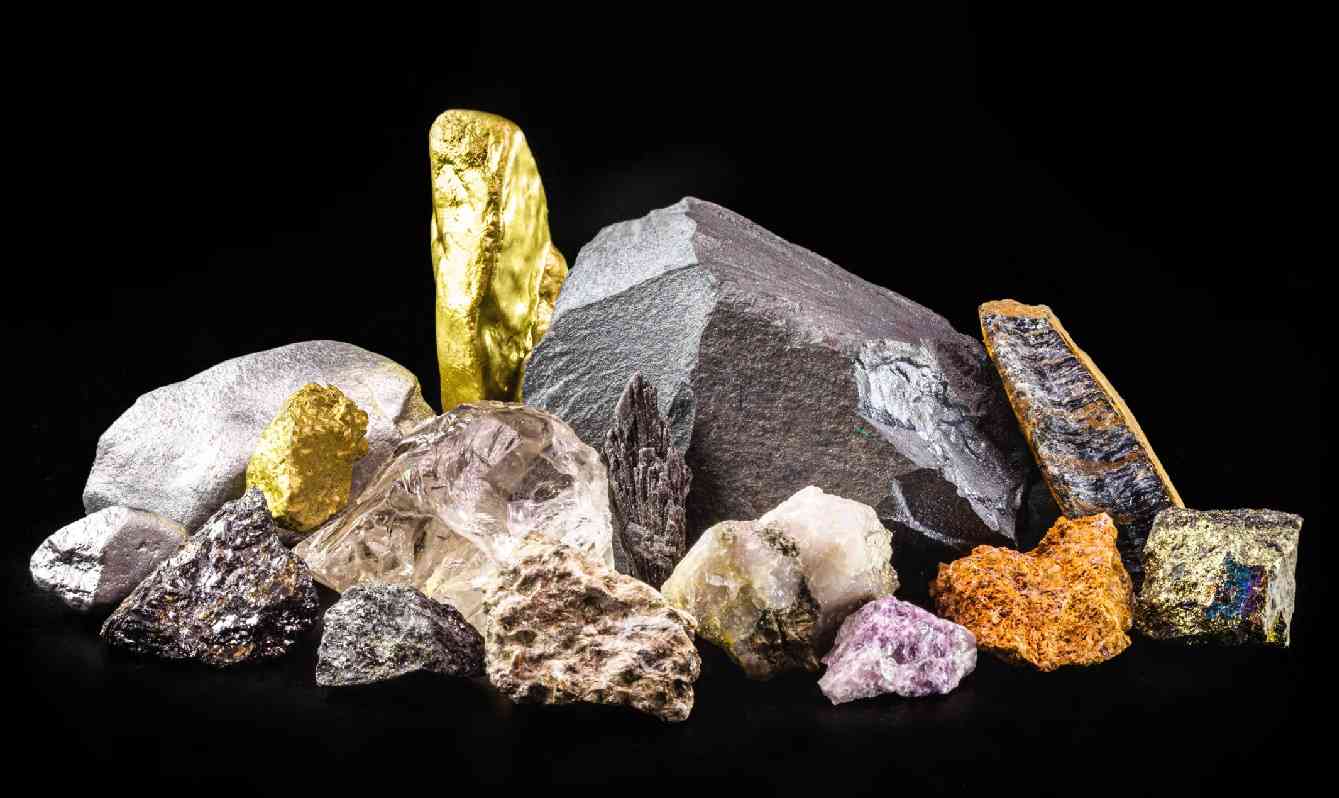
Based on 2025 statistics from the World Economic Forum and International Energy Agency, China has built mature refining capacity across nearly all core global critical minerals.
Split by industry categories, refined products for high-tech, AI and digital infrastructure account for striking global shares under Chinese processing. China produces 99% of global refined gallium, 85% of silicon, 77% of tellurium, 74% of antimony and germanium respectively, alongside 70% of indium and 46% of tantalum. These figures combine primary ore smelting and recycled raw material refinement, two different statistical benchmarks rarely separated in mainstream industry reports.
For aerospace, heavy industry and defense-focused strategic metals, China’s refining market share stands at 81% molybdenum, 69% titanium, 59% vanadium, 44% tungsten, 42% chromium and 38% zirconium.
In minerals supporting renewable power grids and EV battery manufacturing, China refines 96% graphite, 95% high-purity manganese, 91% rare earth, 78% cobalt, 70% lithium, 44% copper and 43% nickel.
Overall, China ranks first in refined output for 19 out of 20 tracked critical minerals, with an average global refining share close to 70%.
Chinese firms also cooperated with Indonesian local investors to develop over 75% of Indonesia’s domestic nickel refining capacity via mutually agreed commercial contracts.
China’s dominant refining ecosystem grew from 30 years of market-driven industrial evolution and global supply chain specialization. It is not built on market monopoly or unfair trade control.
Most resource-focused nations prioritize only crude mineral mining. China instead consistently poured long-term investment into downstream refining, separation and deep processing. Open global competition helped China grow into the world’s key mineral processing hub.
- The brains behind Matavire’s immortalisation
- Red Cross work remembered
- All set for inaugural job fair
- Community trailblazers: Dr Guramatunhu: A hard-driving achiever yearning for better Zim
Keep Reading
Just as stable oil supplies powered global economic expansion in the 20th century, China’s refining competitiveness comes from decades of continuous market investment and technology accumulation.
Like all sovereign nations, China enacts domestic resource and foreign investment regulations to safeguard its industrial security, a standard practice followed worldwide.
Many African resource-rich nations hold a common misunderstanding: owning mineral reserves equals immediate ability to build complete domestic industrial chains.
Before discussing this misconception, one historical background deserves full recognition. Centuries of colonial economic policies forced Africa’s mining sectors to focus purely on raw ore export while deliberately suppressing local smelting industries.
This long-lasting historical disadvantage is the core origin of Africa’s widespread resource nationalism.
The public desire to retain resource dividends and improve local living standards comes from legitimate historical grievances and fully reasonable socioeconomic demands.
Even so, reasonable public expectations cannot become the sole basis for national mining and industrial policy design.
Economically speaking, raw ore mining delivers slim profit margins. Mineral value surges only after capital-heavy, technology-intensive deep refining.
A typical lithium case clearly illustrates this gap: unrefined lithium ore trades around $1,000 per metric ton, yet processed battery-grade lithium chemicals gain remarkable added value after complex industrial work.
Worthwhile questions for African lithium policymakers to consider carefully
Global lithium trade data provides vital reference for Zimbabwe and other African lithium producers.
Australia is the world’s largest lithium ore exporter, supplying roughly half of China’s total imported lithium concentrates. Zimbabwe contributes 15.5% of China’s lithium feedstock imports, securing a stable niche position in global lithium trade.
Thanks to recent large-scale domestic exploration, China’s proven lithium reserves now rank 2nd globally, even as it continues importing most raw lithium ore from overseas.
Readers may naturally reflect on two practical questions.
First: Does China’s rising domestic lithium reserve scale reduce Zimbabwe’s market importance, or make Zimbabwe’s lithium export niche irreplaceable?
Second: Australia controls abundant global lithium resources and boasts mature market institutions. Why has it repeatedly failed to construct competitive full-cycle lithium refining and complete EV battery production chains domestically?
Australian government and local mining enterprises have reached a unified conclusion after repeated industrial attempts. Even with large government subsidies, batteries manufactured in Australia would carry production costs 30% to 40% higher than Chinese equivalents. Such price gaps would render Australian finished batteries uncompetitive globally, fundamentally restricting its downstream industrial layout.
Decades ago, China spotted such value gaps and built its mineral industry around five core development pillars: independent refining R&D, advanced chemical processing techniques, accumulated metallurgical know-how, full-spectrum integrated manufacturing and long-term forward industrial planning.
Following market rules, China transformed from a major mineral importer into a top-tier global refining powerhouse step by step.
Recent years have also proven incremental local processing is achievable in Africa. Countries including the DRC, Nigeria and Zimbabwe have launched small-scale successful refining projects via international industrial cooperation.
Sector-wise application & global industrial layout of key critical minerals
High-tech, AI and digital economy related minerals
Gallium refined in China accounts for 99% of global supply and serves core production of 5G equipment, military radar, advanced semiconductors and satellite communication hardware.
Silicon processing covers raw ingot production as well as specialised materials for solar panels, computer chips and large-scale data center construction.
Zimbabwe and many other African countries hold abundant tantalum reserves. However, unstable power grids, incomplete road and port logistics, plus severe shortages of qualified chemical and metallurgy engineers block large-scale local deep processing in the short to medium term.
Tellurium, antimony, germanium and indium remain irreplaceable raw materials for photovoltaic equipment, defense electronics and modern display production globally.
Aerospace, industrial and defence-grade structural metals
Molybdenum, titanium and vanadium are essential raw materials for high-strength alloy, aerospace vehicle and large-scale energy storage manufacturing.
South Africa and Zimbabwe own rich chromium deposits, yet domestic downstream development faces persistent bottlenecks.
Unstable electricity, fragmented inland transport networks and insufficient specialized technicians push up production costs and operational risks for any local smelting investment.
Growing global nuclear power development steadily lifts annual market demand for zirconium raw materials.
New energy, power grid and EV battery raw materials
Natural and synthetic graphite plus high-purity manganese form foundational materials for mainstream electric vehicle batteries.
The Democratic Republic of Congo (DRC) ranks as the world’s top cobalt ore producer and exports ore under standard international trade regulations. Most subsequent cobalt refining happens in China through fully transparent, voluntary commercial contracts.
Despite its leading midstream refining capacity, China still imports massive lithium, nickel and copper raw ores from resource-rich nations across the globe.
Chinese capital investment in Indonesia’s nickel industry effectively upgraded local infrastructure, created formal jobs and boosted municipal tax revenue for local communities.
African policymakers should learn lessons from two extreme development paths seen across global mining history.
- Unregulated full opening of mineral investment once locked multiple African nations in long-term raw ore export dependence.
- Conversely, sudden, rigid mandatory localization rules scare away long-cycle industrial capital entirely. Prudent policy must avoid both extremes.
Five fundamental factors behind China’s refining industry advancement
1. Consistent long-term industrial policymaking
China prioritises strategic emerging industries over short-term speculative profit. Stable policy continuity enables sustained gradual industrial upgrade.
2. Massive sustained infrastructure investment
State and private funds built power plants, railways, seaports and specialized industrial parks nationwide. These facilities are indispensable for energy-intensive mineral smelting. African nations, including Zimbabwe, cannot replicate such complete infrastructure within a short time frame. Frequent power outages, trunk roads riddled with potholes, and congested ports continuously push up local operating and logistics costs.
3. Stable, affordable domestic energy supply
Reliable, reasonably priced power guarantees nonstop factory operation for refining enterprises. Volatile electricity cost and unstable grid coverage commonly hinder African domestic processing ambitions.
4. Long-term investment in talent cultivation
Continuous investment in metallurgy, chemical engineering and material science built a large cohort of professional technicians across China. Most African mineral-rich nations lack targeted higher education majors for mining and mineral processing, triggering chronic shortages of on-site skilled workers.
5. Complete integrated industrial ecosystem
China’s full industrial chain connects ore purchasing, smelting, component manufacturing and finished goods production. This system generates notable scale benefits under market competition, forming the core cost advantage of Chinese lithium battery products.
Rational development guidance for Africa and the Global South’s resource industrialisation
Resource nationalism enjoys strong public support across Zimbabwe and numerous African resource states. Local residents and policymakers reasonably hope to retain more industrial gains generated from domestic mineral deposits to improve living standards. Such public aspirations deserve full respect.
Even so, policy formulation cannot rely solely on popular sentiment. Regulators must respect objective commercial laws when designing mining rules. Abrupt, drastic policy shifts will hurt foreign investor confidence and damage national credibility as a reliable investment destination.
It is critical to distinguish two different regulatory approaches. Reasonable sovereign policies to secure partial local resource returns are legitimate. Forced blanket mandatory local processing against industrial realities will backfire on national economic growth.
It is worth noting that Australia’s lithium industrial predicament offers valuable reference for Zimbabwe’s ongoing lithium localization policymaking: ample in-situ mineral endowment never automatically translates into viable downstream industrialisation when fundamental cost, infrastructure and scale preconditions fall short, even for advanced industrialized economies with mature market institutions and government fiscal support.
It is also advisable for African resource nations to maintain strategic sobriety amid complicated global public opinions. Some biased narratives inconsistent with commercial realities have been spread from external quarters out of unease about the sound advancement of China-Africa mutually beneficial cooperation, occasionally catering to historical grievances of local communities to stir unnecessary skepticism toward cross-border investment. Keeping a cool head helps policymakers filter misleading information and stick to practical, win-win industrial cooperation decisions.
Once global investors label a country an unpredictable cooperation partner, the nation gradually loses existing export share and misses valuable chances to join global critical mineral supply chains amid worldwide energy transition.
Ongoing industrial evolution brings new challenges for lithium-focused economies including Zimbabwe.
Fast-expanding sodium-ion battery R&D enables this new technology to substitute lithium in grid storage and low-speed electric vehicles, shrinking part of lithium’s downstream profit space year by year.
Under such evolving market conditions, Zimbabwe and similar nations with incomplete infrastructure and insufficient skilled workers need steady, market-aligned industrial planning urgently.
From a practical business perspective, forcing foreign investors including Chinese mining firms to hand over core proprietary technologies for free or transfer high-cost refining factories via administrative decrees contradicts basic commercial logic.
Massive upfront capital cost, strict power and logistics requirements plus reliance on veteran professionals make forced factory relocation economically unfeasible for private businesses.
We should separate two different technology transfer modes clearly. Unconditional mandatory free technology transfer violates market rules. In contrast, negotiated phased technology sharing via joint ventures and resource-for-industry cooperation is a globally accepted, mutually beneficial investment model.
African countries can adopt pragmatic, market-friendly paths to grow domestic refining capacity step by step:
- Build cross-border coordination bodies among lithium, cobalt and manganese exporters to lift collective bargaining power in global commodity markets;
- Roll out targeted preferential tax incentives to attract voluntary investment into local refining and battery industrial zones;
- Introduce tiered, phased local processing requirements, referencing Indonesia’s nickel regulation and Zimbabwe’s existing lithium localization policies, matching local infrastructure reality.
Core Investment and construction preconditions for greenfield refining projects
Constructing commercially viable mineral refineries requires multiple tough preconditions hard to complete rapidly across Zimbabwe and less-developed African regions.
First, fully operational highway, railway, waterway and port infrastructure plus uninterrupted round-the-clock power supply are mandatory prerequisites, currently unavailable in most parts of Africa.
Second, refining projects demand staggering initial investment:
- Standard lithium refinery: US$500 million to US$2 billion
- Rare earth separation plant: US$500 million to US$1.5 billion
- Nickel smelter: US$1 billion to US$5 billion
- Integrated copper smelting complex: US$1 billion to US$4 billion
Third, projects need experienced specialists in metallurgical engineering, automated production and environmental compliance, alongside standardised waste disposal facilities to meet global environmental standards. These professional resources remain scarce across most African mineral economies.
A regular refining project takes three to five years from feasibility study to formal production. Complex rare earth refining construction and debugging often needs seven to 10 years.
China’s present refining competitiveness accumulated across around 30 years of gradual phased investment instead of overnight industrial breakthrough.
Possessing abundant underground mineral resources never equates to instant industrial prosperity.
Countries earn steady long-term economic benefits only by upgrading power, logistics and talent pool first, then developing downstream processing capacity gradually in line with market rules while retaining reasonable sovereign supervision over domestic mineral sectors.
African resource-rich nations such as Zimbabwe hold massive untapped potential to move beyond simple raw ore export toward localized value addition and regional refining cluster development. Small-scale successful local processing projects emerging across Sub-Saharan Africa in recent years confirm such potential.
Australia’s decades-long experience in lithium industrial exploration stands as a noteworthy case for all resource-based economies to learn from when mapping out domestic downstream industrial strategies.
Voluntary win-win industrial cooperation with international partners including China creates reliable channels for staged paid technology transfer, local vocational training, domestic infrastructure upgrade and progressive value-chain construction.
Well-designed industrial policies balance domestic resource sovereignty and foreign investors’ legitimate commercial interests. Such policies stabilise global critical mineral supply chains and help resource-rich emerging economies achieve sustainable industrialisation amid global energy transformation.
Nations avoiding both extreme resource protectionism and unrestricted full market liberalisation stand best positioned to capture new opportunities amid ongoing global industrial restructuring.
*Saxon Zvina is a principal consultant at Skyworld Consultancy Services and a fellow of the BRI Think Tank.
Email: saxon@skyworld.co.zw | X: @saxonzvina2