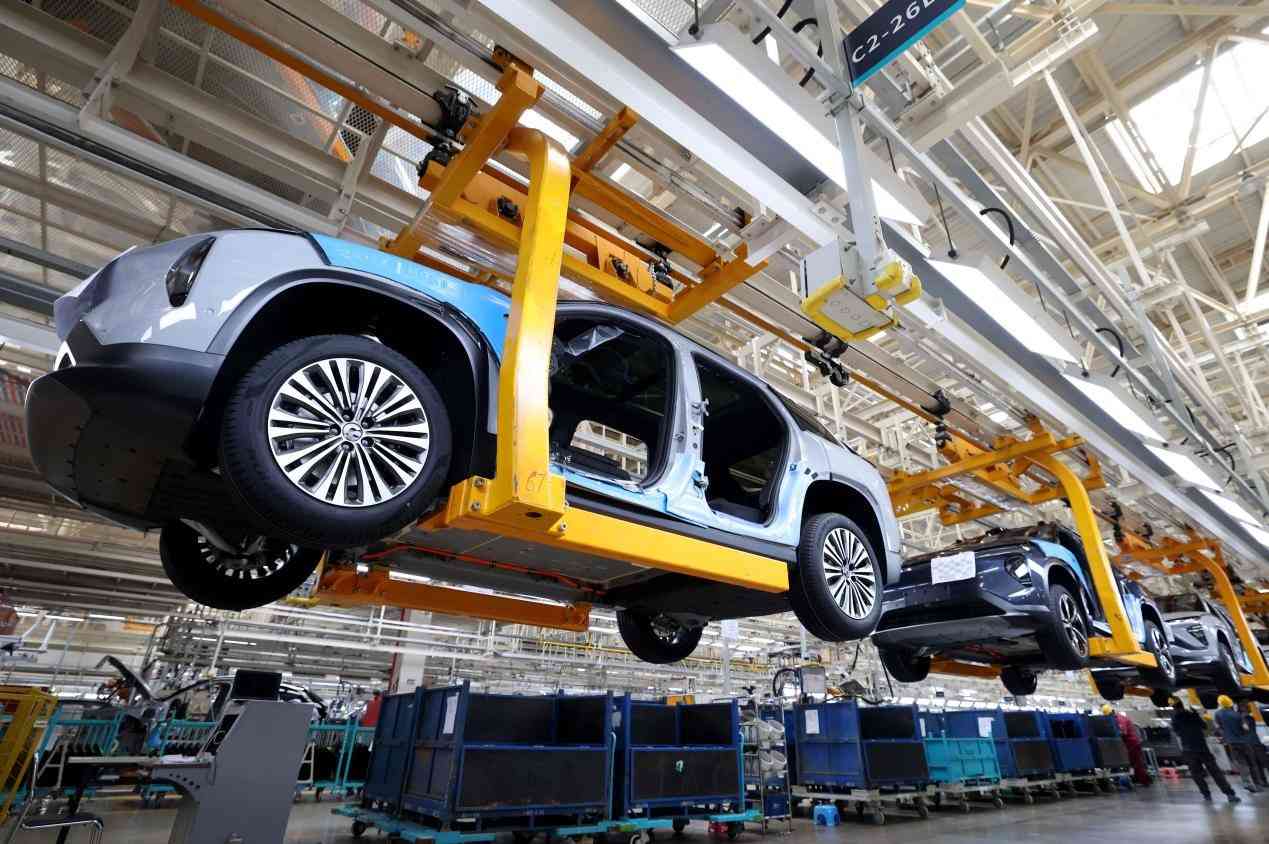
China’s new-energy vehicle exports reached 1.384 million units in the first four months of 2026, surging 120% year on year.
This is far more than a commercial milestone. It represents a structural transformation in global automotive manufacturing, green technology diffusion, and development pathways.
For the Global South and Africa, this moment offers unprecedented opportunities and strategic imperatives.
The key question is not whether to engage with China’s NEV ecosystem, but how to do so on terms that build lasting industrial capacity without unrealistic demands for full local industrialisation, given Africa’s weak hardware, software, and funding conditions.
The wisest path is to learn from China’s incremental approach and ride its development wave through practical, feasible, and commercially sustainable cooperation.
The logic behind China’s NEV success
China’s NEV success is no accident. It is the result of deliberate strategy, sustained policy support, and full industrial chain integration.
Today, NEVs account for 53.2% of all new car sales in China, meaning electric vehicles have moved from a niche segment to the mainstream of the domestic market.
- Open letter to President Mnangagwa
- Feature: ‘It’s worse right now than under Mugabe’: Sikhala pays the price of opposition in solitary cell
- The brains behind Matavire’s immortalisation
- Masvingo turns down fire tender deal
Keep Reading
Export growth has kept pace with production expansion, proving that China has resolved the dual challenges of large-scale domestic adoption and international competitiveness at the same time.
For developing nations, the most important insight is that China did not build its entire industry overnight.
It started modestly, expanded step by step, and used domestic scale to drive down costs before competing globally.
Africa does not need to copy China’s full supply chain; it only needs to learn how to catch the ride through focused, low-barrier cooperation.
The core engine of China’s advantage is its technology-cost flywheel. China dominates more than 80% of global lithium-ion battery production capacity.
It has pioneered digital-native vehicle architectures that integrate artificial intelligence, the Internet of Things, and mobile ecosystems. With every doubling of cumulative production, costs fall by 18 to 22%, creating a self-reinforcing cycle of competitiveness.
For the Global South, this means Chinese NEVs are becoming the most affordable and reliable option in the global market.
Practical opportunities for Africa amid real constraints
For Africa, the biggest advantage is not in building a full NEV industry from scratch, but in accessing affordable green transport, reducing oil dependency, creating jobs in services and light manufacturing, and improving trade balances.
Most African countries lack the capital, infrastructure, skilled labor, and industrial support systems to pursue deep processing or full industrial chains in the short to medium term.
Attempting full local manufacturing would be commercially unviable and fiscally unsustainable.
Instead, Africa’s realistic strategy is to absorb Chinese NEV technology in gradual, low-cost, high-impact ways: expanding electric public transport, deploying charging infrastructure with Chinese support, simplifying import regimes for reliable NEVs, and building lightweight assembly capacity rather than capital-intensive component making.
The Global South represents over 80% of the world’s population but has contributed less than 20% of historical emissions.
Yet it suffers the most severe climate impacts. NEVs offer a realistic pathway to leapfrog the internal combustion engine era entirely, avoiding both the heavy carbon footprint and the crippling fuel import dependency that drains foreign exchange reserves.
Africa’s realistic path: Ride the wave, not rebuild the wave
Africa’s automotive sector is highly fragmented. Only South Africa, Morocco, and Egypt have established assembly industries.
Most other countries depend entirely on imported used vehicles, over 80% of which come from Europe, Japan, or China. NEV penetration remains below 2% of the total vehicle fleet.
Yet Africa’s potential is catalytic. It holds vast reserves of cobalt, lithium, copper, manganese, graphite, and platinum-group metals—all critical to the global EV and battery supply chain.
It also has the world’s highest solar irradiation, making it possible to pair NEV charging with mini-grids and bypass weak national electricity systems.
The most practical lesson from China is not about building full industrial chains, but about using policy to create markets, attract investment, and upgrade gradually.
China did not start with battery factories; it started with subsidies, pilot projects, and public fleet electrification. African countries can replicate this model.
How to truly cooperate with China: Feasible, commercial, and gradual
The greatest danger for Africa is pursuing unrealistic industrial ambitions that waste scarce resources. Instead, Africa should focus on commercially viable steps that align with Chinese corporate interests and African development needs.
First, import high-quality, affordable Chinese NEVs to replace aging, high-polluting fuel vehicles, especially in public transport.
Second, develop lightweight, low-investment assembly to reduce transport costs and create basic jobs.
Third, use raw material resources as a basis for stable, long-term cooperation.
Fourth, build charging infrastructure and maintenance systems with Chinese concessional loans and technical support.
This model allows Africa to ride China’s development express without shouldering the cost of building an entire industrial system.
Policy, industry and skills: A pragmatic action agenda
To turn opportunity into lasting progress, the Global South and Africa must act across policy, industry, and workforce development.
In the short term, countries should conduct national NEV readiness assessments, establish minimum battery safety and warranty standards, adjust tariffs to favor stable NEV supply, and require long-term software and parts support.
Over the medium term, governments should use green bonds and development bank financing to electrify public transit fleets and establish basic maintenance and recycling systems.
In the long term, they may gradually pursue simple technology licensing and localised assembly as conditions improve.
Strategic lessons Africa can actually apply
China’s two-decade journey to NEV leadership offers four highly practical lessons for Africa.
First, industrial transformation requires patience, not instant heavy industry. Second, the state must create demand, not just regulate it.
Third, development comes from learning by doing, not aiming for impossible industrial goals.
Fourth, regional markets are the only way to achieve scale for small economies.
While cooperation offers great promise, countries must maintain policy sovereignty.
Transparent financing, competitive tendering, technical interoperability, and strong environmental and labor standards ensure that partnerships remain sustainable and mutually beneficial.
In conclusion, China’s NEV export surge represents a global structural shift. For Africa and the Global South, the choice is not whether to engage, but how to shape the relationship realistically.
Most African countries cannot build full NEV industrial chains in the foreseeable future.
But they can learn from China’s policy wisdom, adopt gradual industrial paths, and ride China’s development wave through practical, commercial, and achievable cooperation.
By focusing on electrifying public transport, encouraging lightweight assembly, stabilising mineral supply cooperation, building simple maintenance capacity, and acting through regional unity, Africa can truly benefit from China’s NEV success without unsustainable costs.
The next five years will determine whether Africa becomes a passive market or a proactive partner in the global energy transition.
* Saxon Zvina is a principal consultant and political analyst at Skyworld Consultancy Services, Harare, Zimbabwe. He can be reached at Email: saxon@skyworld.co.zw and X handle @saxonzvina2