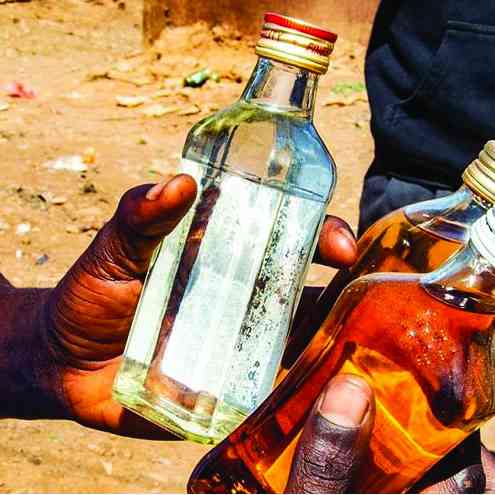
CONCERNS over the sale and abuse of unregulated alcoholic substances, such as ''Tumbwa'', have exposed gaps in the country’s legal framework, with legislators questioning why suspected offenders are repeatedly arrested but released by the courts.
The issue was raised in the National Assembly by Rushinga legislator Tendai Nyabani, who told Parliament that police were struggling to secure convictions against people accused of selling the substance.
Nyabani said authorities were making arrests, but suspects were being discharged due to the absence of clear legal provisions dealing with the substance.
“In Rushinga, where I come from, beer called ‘Tumbwa’ is being sold. The police are arresting those people, but when they go to the courts, they are not being convicted because it is said that there is no law against that,” Nyabani said.
He told Parliament that he had personally seized some of the substances, adding that law enforcement officers were facing challenges in dealing with the problem.
“I want to know what can be done by the government to arrest those people and put them in custody because each day they are being taken to court, but they are not convicted and sent to prison,” he said.
Health and Child Care minister Douglas Mombeshora said he could not comment on court decisions and advised that specific cases be referred to the relevant authorities.
“I ask that he gives examples or write to the relevant ministry. Maybe he might get an appropriate answer,” Mombeshora said.
- In Full: Nineteenth post-cabinet press briefing: July 05, 2022
- Hesitancy slows Covid vaccination for children
- Hesitancy slows Covid vaccination for children
- Multisectoral COVID-19 messaging campaign improving prevention and vaccine uptake in Zimbabwe
Keep Reading
The debate also shifted to the country’s preparedness to rehabilitate people affected by drug and substance abuse, with legislators questioning whether existing systems were adequate to deal with the growing crisis.
Emakhandeni-Luveve MP Discent Collins Bajila said while enforcement against the sale of harmful substances was important, attention was also needed on recovery and rehabilitation.
He asked: “My question is in terms of our readiness and our capacity for the rehabilitation of people who have consumed and abused these substances.
“How prepared is the government and what programmes and systems are there in government for rehabilitation to the extent of recovery from addiction or from abuse of these kinds of substances?”
Mombeshora said the government was expanding rehabilitation services, but acknowledged that limited resources remained a challenge.
“The government is in the process of establishing treatment and drug rehabilitation centres throughout the country,” the minister said.
“The problem is so huge that it will take us quite some time because of limited resources to be able to establish enough rehabilitation centres throughout the country”.
Mombeshora said four new rehabilitation centres had been opened in the past year, with plans to establish facilities in every province.
He added that land had already been identified for larger rehabilitation facilities and encouraged private players to support government efforts.
Meanwhile, Justice, Legal and Parliamentary Affairs minister Ziyambi Ziyambi said existing laws provided for the control of dangerous drugs, but additional substances could only be prohibited after proper assessment and legal processes.
He said authorities needed to examine substances such as 'Tumbwa' before they could be added to the list of prohibited substances.
“We have legislation that is in place that speaks to the issue of dangerous drugs, which is under the Ministry of Health and Child Care,” Ziyambi said.
“We would want to see what exactly was taken to court and whether it was examined to see the alcohol content in that drink so that that drink is also put in the statutory instrument which states that these substances are not allowed to be consumed.”
Ziyambi also revealed that Parliament was considering a Bill aimed at strengthening measures against drug and substance abuse.
“When we are looking into that Bill, we can then discuss and come up with what exactly can be incorporated in that Bill so that we have strict measures to fight against the issue of drug and substance abuse,” he said.
'Tumbwa' is only the latest name in a decades-long cycle in which home distillers invent a new concoction, authorities eventually move to outlaw it, and producers respond by rebranding under a different name.
The pattern dates back further than most Zimbabweans realise.
The best-documented case is kachasu, a potent maize-based spirit also known in some circles as tototo or nipa.
Brewers ferment maize meal, sometimes substituting millet, fruit or banana peels, before distilling it over an open fire, producing a spirit whose alcohol content can swing wildly between roughly 9% and 41%, depending on how it is made.
Its sale and consumption have been illegal in Zimbabwe since 1971, largely because the unregulated distillation process has long been linked to poisoning and sudden deaths.
The government has periodically expanded the list of banned liquids under the Harmful Liquids Act as new brews emerge.
Substances outlawed over the years include Skokiaan, Barberton, Qilika, Isityimiyana, Hopana, Qediviki, Uhali, Kachasu and Nipa.
In June 2025, Home Affairs minister Kazembe Kazembe gazetted a further amendment, adding ethanol-laced concoctions sold as “kambwa” or “musombodhiya” to the list of those formally banned.
Rather than naming a single product, the amendment was deliberately worded to cover any unregulated or illegally produced alcoholic beverage containing ethanol “by any other name whatsoever,” an attempt to close the loophole that lets producers dodge the law simply by rebranding.
That loophole is precisely the gap Nyabani described to Parliament; because 'Tumbwa' itself does not yet appear on the gazetted schedule, prosecutors have struggled to secure convictions even where arrests are made.
Researchers who have studied the informal brewing sector note that enforcement remains patchy nationwide, with dozens of alcohol-related arrests recorded monthly despite the existing legal prohibitions.
The economics behind the trade have also stayed constant across generations of banned brews, as home distillation persists largely because commercial, regulated alcohol remains unaffordable for many Zimbabweans, keeping demand for cheap illicit alternatives high even as the list of banned substances grows.