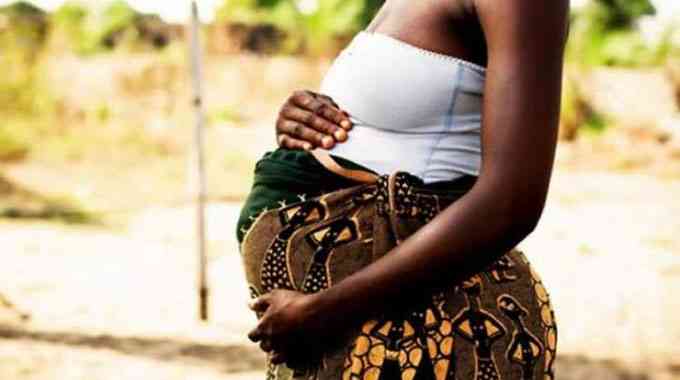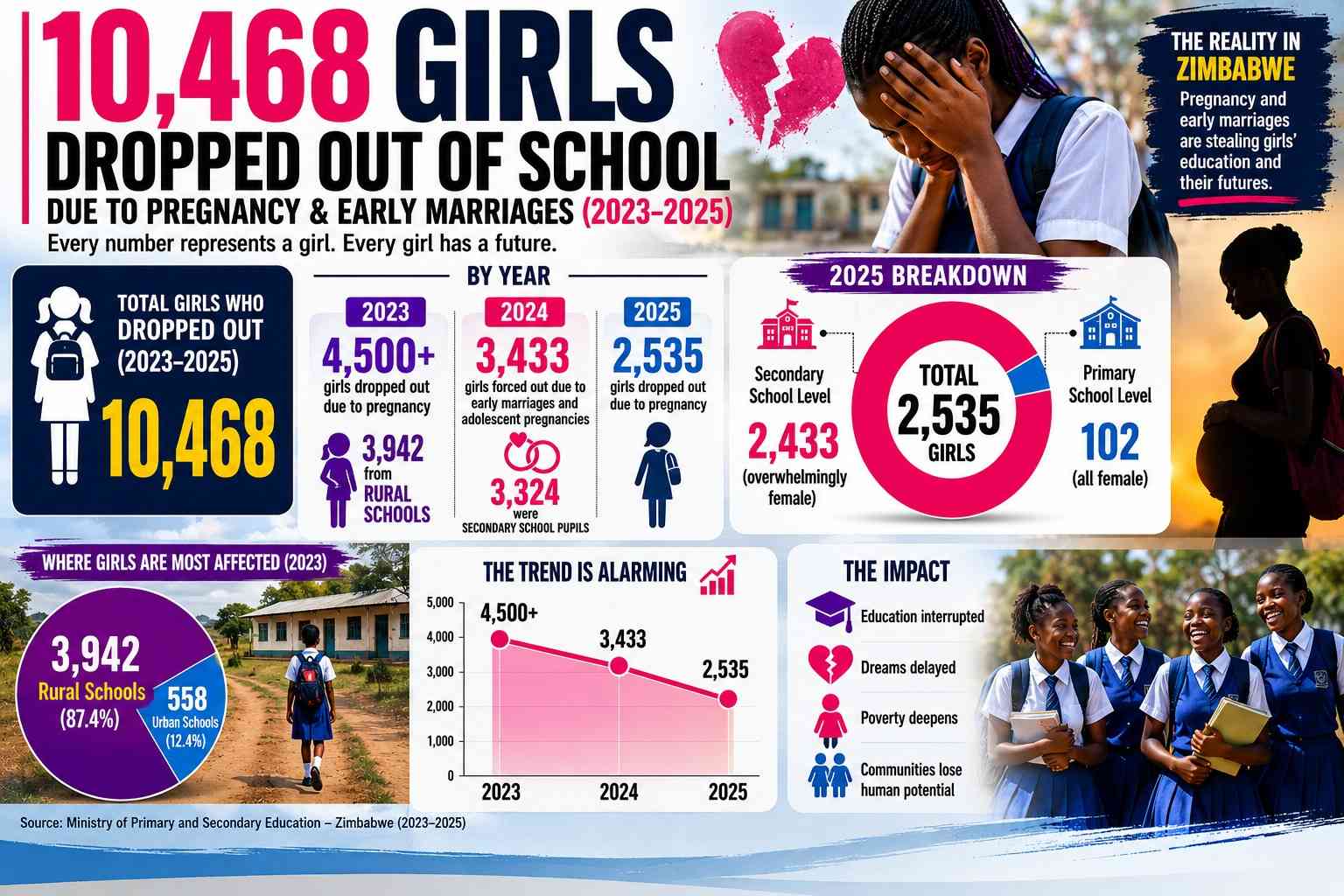
MORE than 10 000 teenage girls dropped out of school across Zimbabwe between 2023 and 2025 due to pregnancy and early marriage, according to official data from the Primary and Secondary Education ministry.
These statistics present a worrying picture of the challenges facing girls within the education system, showing that despite legal frameworks designed to keep pregnant learners in school, thousands continue to have their education cut short.
The figures highlight a persistent national crisis in which teenage pregnancy and child marriage drive high dropout rates, particularly in rural areas.
This underscores significant gaps in protection, the enforcement of education policies and social support systems required for vulnerable learners.
According to government data, the crisis spans primary and secondary levels, with rural communities bearing the heaviest burden.
A breakdown of the figures shows a consistent trend over the three-year period.
In 2023 alone, more than 4 500 girls dropped out due to pregnancy, with 3 942 of the cases recorded in rural schools, highlighting a stark urban-rural disparity.
In 2024, the ministry recorded 3 433 school dropouts linked to early marriage and adolescent pregnancy.
- Mayhem as schools reject Zimdollar fees
- Govt pleased with teacher turnout, but ...
- Govt warns schools turning away learners
- Teachers’ strike in bumpy start
Keep Reading
Secondary school learners accounted for the majority of these cases, with 3 324 pupils leaving school to become teenage mothers or wives.
By 2025, 102 girls had dropped out of primary school due to pregnancy, indicating that learners as young as 12 or 13 are falling pregnant while in primary school.
At the secondary level, 2 433 girls dropped out for the same reason.
In an interview with NewsDay, Primary and Secondary Education ministry spokesperson Taungana Ndoro acknowledged that teenage pregnancy remained a major challenge.
“The ministry has been implementing targeted programmes to address this, including Circular 18, which allows pregnant learners and young mothers to continue or resume their education without discrimination,” Ndoro said.
He noted that schools maintain detailed records of learners who drop out, with pregnancy-related cases recorded as a specific category.
The ministry is also engaging community leaders and parents to encourage the return of young mothers to the classroom.
Furthermore, measures have been implemented to reduce stigma and support reintegration.
“The ministry has a School Health Programme that provides psychosocial support, including individual and group counselling sessions,” Ndoro added.
However, education experts argued that these figures represent a tragic loss of human potential and a deep-rooted social crisis requiring urgent intervention.
Educators Union of Zimbabwe secretary-general Tapedza Zhou emphasised that reintegrating teenage mothers is essential for upholding the right to education.
“The reintegration of teenage mothers . . . must be founded on the principle that every child has a right to education and should be accorded a second chance,” he said. He suggested that stigmatisation can be reduced if schools strengthen guidance and counselling, promote empathy and enforce safeguarding circulars against bullying.
Gender rights organisations, such as Shamwari yeMwanasikana, have intensified efforts through mentorship programmes like Sister-to-Sister (Dandaro).
Ekenia Chifamba, Shamwari yeMwanasikana director, said the initiative provided peer support systems to encourage girls to return to school despite the challenges of motherhood.
Kudakwashe Munemo of the Institute for Young Women’s Development (IYWD), noted that the issue extends beyond the classroom.
“This is not only an education issue, but also a serious sexual and reproductive health rights, child protection and gender equality concern,” she said.
The IYWD works to create safe spaces where girls receive information on bodily autonomy and the prevention of unintended pregnancy.
Additionally, Walter Vengesai, director of the Padare/Enkundleni Men’s Forum on Gender, stated that men bear a significant responsibility.
The organisation is educating men on the legal age of consent, now set at 18, to reduce these numbers.
This crisis reflects a global struggle; while adolescent birth rates have nearly halved over the last 30 years, a recent Unicef report estimates that 12 million girls aged 15 to 19 gave birth last year.
The report, Fast Facts: 30 years of uneven progress for adolescent girls, warns that more than 325 000 girls aged 10 to 14 are expected to give birth annually, facing severe health and social risks.