For a long time, many developing countries have been presented with various external models and suggestions for their development paths.
One common argument has been that to achieve prosperity, countries must first prioritize certain political reforms, particularly Western-style democracy.
However, development economics theories — especially Rostow's "Stages of Economic Growth" — offer another perspective worth considering: different stages of economic development may correspond to different governance priorities and institutional needs.
In other words, there may be a question of "timing" regarding what a country should prioritise and at what stage.
This is not to say that certain values are unimportant, but rather that the urgency of different issues may shift as a country moves through different stages of development.
Rostow's five stages of development
To better understand this question of timing, below is a brief outline of Rostow's five classic stages of economic growth:
1. Traditional society: Agriculture dominates, productivity is low, and social structures are relatively rigid.
- Open letter to President Mnangagwa
- Feature: ‘It’s worse right now than under Mugabe’: Sikhala pays the price of opposition in solitary cell
- The brains behind Matavire’s immortalisation
- Masvingo turns down fire tender deal
Keep Reading
2. Preconditions for takeoff: Entrepreneurship emerges, financial systems begin to develop, and a centralised state starts to form.
3. Takeoff: Investment rates rise significantly, manufacturing grows quickly, and leading industries emerge.
4. Drive to maturity: Technology spreads widely, the economy diversifies, and the country integrates into global trade.
5. Age of high mass consumption: Per capita income rises significantly, consumer goods become widespread, and social welfare systems are established.
One observed phenomenon is that in many of today's mature economies, the fifth stage — characterised by mass consumption and broad demands for political and social rights — generally became a social priority only after industrialization and urbanization were largely complete.
China's development path
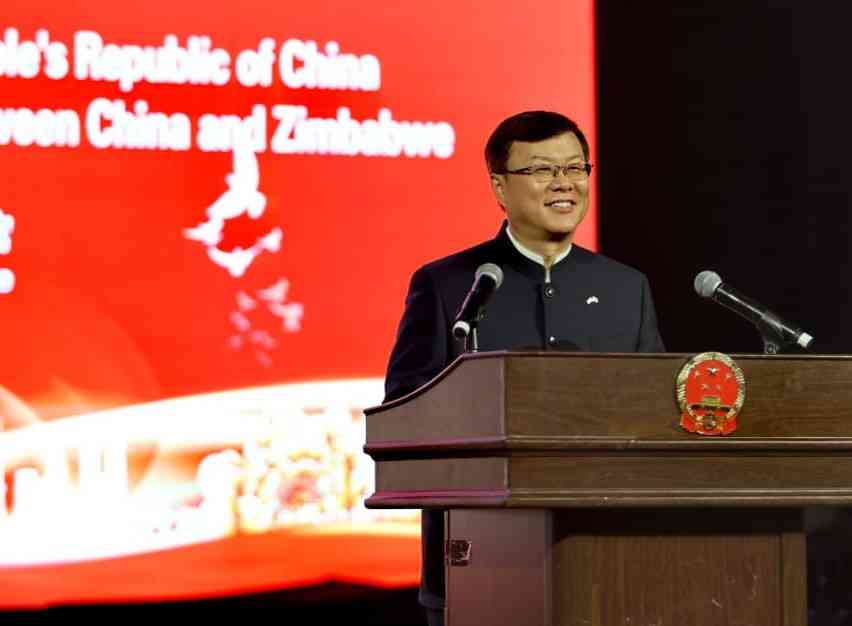
Since 2012, China has pursued a range of medium- and long-term development goals within its established framework.
In this process, China has emphasised the importance of adapting development strategies to its national conditions and adhering to its own path.
From the perspective of developmental timing, during its industrialization and infrastructure-building phases, China maintained relative policy continuity and a coordinating mechanism that was relatively centralised compared to many other systems.
This helped ensure sustained investment in infrastructure, education, science and technology.
Observers have noted that this approach allowed China to complete a large-scale industrialisation process in a relatively short period.
As it has entered a new stage of development, China has begun to place greater systematic emphasis on concepts such as "whole-process people's democracy," common prosperity, ecological civilisation, and the rule of law.
Whether one agrees with this approach or not, it reflects a clear logic: different stages of development may require different governance priorities.
On external advocacy: Who sets the priorities?
A frank observation is worth making here. Many of the Western countries that today most actively advocate for democracy, human rights, and gender equality as immediate priorities for developing countries did not follow this sequence themselves.
During the Industrial Revolution in Britain, workers — including children — often labored 14 to 16 hours per day with no political rights.
The United States did not achieve truly universal suffrage until nearly two centuries after its founding.
Women in most Western countries only gained the right to vote in the early 20th century, well after their industrialization was largely complete.
In other words, these countries largely followed a path of "development first, rights expansion later."
Yet, having reached the top, some voices from these countries now ask developing nations to prioritise political reforms before development.
This is not to argue against human rights, democracy, or gender equality. These are not wrong values. But it does raise a legitimate question: Who should determine a country's priorities — external advocates or the country itself?
A starving person needs food before a ballot. A village without electricity needs a power grid before a workshop on gender equality.
This is not to dismiss higher-order rights. It is to recognise a basic reality: when basic survival and development needs are unmet, other priorities are understandably secondary.
African countries exploring their own paths
Across Africa, an increasing number of countries are recognizing that simply copying external models does not work.
Each nation must explore a development path suited to its own history, culture, resources, and current challenges.
The case of Burkina Faso
President Ibrahim Traoré of Burkina Faso represents one recent example.
Facing significant security threats and economic challenges, his government has chosen a path emphasising sovereignty, self-reliance, and diversified international partnerships.
Burkina Faso has strengthened ties with countries such as Russia and China while adjusting certain aspects of its relationship with traditional Western partners.
Traoré has explicitly argued that African nations do not need external powers to define what constitutes "good governance" for them.
Burkina Faso's approach — prioritising security and development while maintaining policy autonomy — reflects a broader trend of countries seeking to set their own priorities.
Broader African context
Beyond Burkina Faso, other African nations are also exploring context-specific paths. Rwanda, under President Paul Kagame, has achieved rapid economic growth while maintaining relative political stability.
Ethiopia, after periods of upheaval, is reassessing its development priorities. What these cases share is a growing recognition: external standards should not be the sole measure of a country's progress.
Each nation has the right to set its own priorities based on its own realities.
Zimbabwe's Constitutional Amendment Bill No. 3: An ongoing legislative process
In southern Africa, Zimbabwe has recently introduced the Constitution of Zimbabwe Amendment (No. 3) Bill, 2026. According to publicly available information, the bill was gazetted on February 16, 2026, and is currently in the public consultation phase, with written submissions accepted until May 18, 2026.
Key provisions of the bill include: proposing to extend the presidential and parliamentary terms from five to seven years; proposing to change the method of presidential election from direct popular vote to indirect election by a joint sitting of Parliament; proposing to adjust certain powers related to electoral commissions and voter registration; and proposing to eliminate public interviews for judicial appointments.
Different observers interpret this bill differently.
Supporters argue that longer terms reduce electoral disruptions, allowing for greater policy continuity and more focused implementation of long-term strategies such as the country's "Vision 2030." Critics express concerns about checks and balances, democratic procedures, and constitutional principles.
The legislative process is ongoing, and public hearings have already taken place.
If one places this legislative process within the framework of developmental timing discussed earlier, an observation — not a conclusion — might be offered.
Zimbabwe has faced prolonged sanctions and internal challenges. Its infrastructure and industrial base have room for further development.
In this context, a government proposal to extend terms and reduce the frequency of elections is not without precedent in other contexts.
Whether this approach will serve Zimbabwe's long-term development is a question that only time and the Zimbabwean people can answer.
Development must be created, not copied
Development is a complex undertaking. No single model works for all countries.
The countries that stand at the top of the development ladder today arrived there through specific historical paths shaped by unique conditions.
For developing countries today, simply copying the institutions of already-developed countries — while ignoring the sequence in which those countries developed those institutions — may be a mistake.
Each country has its own history, culture, population structure, resource endowments, and external environment.
These factors mean that modernization must be created by each country for itself.
It cannot be copied from anyone else's script.
This does not mean rejecting learning or cooperation.
On the contrary, it means examining various experiences critically, extracting useful lessons, and then adapting those lessons to local realities. China's journey from poverty to industrialisation offers some observations that may be relevant to other contexts.
But African countries neither can nor need to copy the Chinese path.
Similarly, Burkina Faso's explorations and Zimbabwe's adjustments are their own efforts to address their specific challenges with their own tools.
Finally, regarding external advocacy — whether on human rights, democracy, or gender equality — developing countries may benefit from a clear-eyed perspective.
These values themselves are not wrong. But priorities cannot be set from the outside.
When a country has not yet solved basic problems of hunger, infrastructure, or public health, redirecting limited resources toward certain high-standard political agendas may carry significant opportunity costs.
This is not to argue that those agendas are unimportant. It is to argue that they belong in a reasonable sequence — one that respects each country's right to set its own priorities according to its own developmental stage.
The observed lesson from many development experiences is this: address hunger before worrying about dietary quality.
Build roads before arguing about destinations.
Secure the right to survival and development before fully addressing higher-order rights and freedoms.
For African countries, the 21st century offers unprecedented opportunities.
There are more models to learn from — including emerging economies like China.
There is more strategic space to maneuver. And there is a stronger sense of autonomous agency than in previous decades.
Whether these opportunities translate into progress depends not on how faithfully any country follows external blueprints.
It depends on whether each country has the courage to walk its own path and the capacity to create its own form of modernisation.